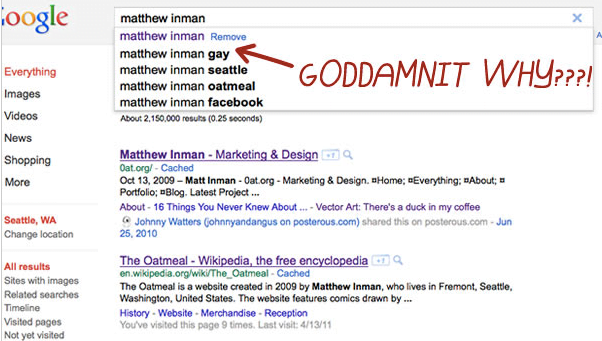
Google's automated search suggestions can potentially change how potential employers view you as satirized above by cartoonist/humorist Matt Inman of The Oatmeal
The number you hear tossed around is that 80% of employers do some level of background checking using the Internet. That’s pretty unbelievable – in the ‘I don’t believe it for a second’ form of unbelievable. Most employers don’t do any sort of background checking.
That said, people who do use the web as a way of vetting candidates ought to have some form of training in reputation management. Understanding what you see online takes some sophistication. And, the problem is just going to get worse.
This is not another screed about the legal risks of using the web to do some level of background checking. People are doing that, going to do more and ought to. The likelihood that a company will be successfully sued on this topic is almost directly proportional to the degree to which it is covered by a policy manual. The more specific the coverage and the more effective the policing, the more likely that there will be a successful suit. That’s the problem with policies and the topic of a different conversation.
The question here is ‘how to avoid doing things that make your hiring process less effective.’ (That’s corporate speak for ‘not doing stupid stuff’.) While the EEOC is never going to figure this one out, the net is changing rapidly and some of the changes can make you miss important things
The title refers to autofill confusion, the new hazard in sourcing. (The geek form, Guilt By Algorithmic Association, doesn’t exactly roll off the tongue.)
Autofill Confusion is a computer generated form of Rickrolling. In Rickrolling,
" a person provides a hyperlink seemingly relevant to the topic at hand, but actually leads to Rick Astley’s video. The link can be masked or obfuscated in some manner so that the user cannot determine the true destination of the link without clicking. Persons led to the music video are said to have been rickrolled." (Wikipedia)
In autofill confusion, as Google tries to guess what you’re looking for, may make suggestions that are misleading. When Google makes suggestions as you search for a specific name, those suggestions create an impression of the person you’re searching for. It turns out that your reputation is now partly a function of what people search for when they search for you.
Effectively, the search engines now amplify reputation with information about what people are most likely to search on when they search for you. This is how the autosuggestions are generated.
This is an impossible area to regulate since recruiters and background checkers use consumer tools. It does, however, expose the silliness of most concerns about the web as a source of discrimination. The only way around these sorts of problems is education and training. Prohibition just makes dumb things more likely.