 Razz and Harass part 1
These days, things change faster than the jargon that describes them. For a couple of decades, it was the other way around. Marketing language evolved faster than reality.
It is much cheaper to make a marketing claim that it is to deliver a customer reality. That’s what fueled the acceleration of language that bore no resemblance to service experience. Today, our categories are strained as we encounter the new normal in economics, business and technology.
Take software. It used to be easy to understand what software was. Wikipedia says:
Computer software, or just software is a general term primarily used for digitally stored data such as computer programs and other kinds of information read and written by computers.
But that’s not really the whole story, particularly in the sort of software that businesses use (regardless of size).
Every piece of software comes with some amount of human support. If it’s from Google, the quantity of humans involved in the delivery of the software is microscopic. If it’s from Oracle, SAP, Peoplesoft or Lawson, just the opposite is true.
Over the years, ‘enterprise software’ became a secret code word for outsourcing. With massive teams that lived onsite, the enterprise implementation team patiently and casually took up the dregs of the customer organization’s work. It was impossible to tell the difference between the software and the team that implemented it. The work slipped off of the customers headcount and into the software supplier’s invoice.
One way of thinking about the Software as a Service (SaaS) revolution is that it is an attempt to restore the balance between the software you pay for and the people you get who support it. At the very least, SaaS is a way of clarifying where the software ends and the team that supports it begins.
It’s every bit as much a way of controlling spiraling costs as it is a way of delivering software. All of that hard to live with hardware maintenance and management is left to people who specialize in it. The very best SaaS providers keep costs in check by limiting customer alternatives to things that can be configured within the application itself.
SaaS is usually priced like a subscription charged at $X per employee. For that money, you get some level of software functionality and ‘account management’ (or customer support). For the most part, your options are limited to the things that the software can be configured to do. In some cases, the degree to which the software is ‘configurable’ is pretty all encompassing.
Last week, I spent an hour on the phone with the leadership of Caliber Point, an Indian HR Outsourcing firm. The leadership team is chock full of seasoned people with lots of enterprise implementation experience. I was fascinated by the fact that they billed on a per employee basis. I asked why they didn’t simply bill themselves as a SaaS offering.
Their answer was instructive. While the SaaS tool they’ve built is clearly the heart of their offering, they want to be known for the intimate service they deliver through their cast of thousands.
I felt like I was seeing an inflection point first hand. Since people are more flexible than software, why not lay the emphasis on the human component. It makes me wonder who competes with whom.
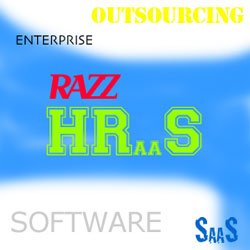
The new category is obviously called HRaaS.